
Looking for a Poe Alternative? Choose by Workflow, Not Model Count
A practical guide to choosing a Poe alternative for multi-model chat, memory, web research, files, images, and simpler everyday AI work.


Updated July 16, 2026
A good Poe alternative should do more than put a different set of model names in a menu. It should fit the way you use AI: how you carry context between chats, research the web, work with files, generate images, switch models, and understand your usage.
Poe is already strong at breadth. Its official overview lists models from several AI companies, user-created bots, image and video generation, web search, multi-bot chats, group chat, and bot-building tools. If those creator and community features are why you use Poe, replacing it may not help.
But if you mostly want a calm everyday workspace for Claude, GPT, Gemini, Grok, DeepSeek, Qwen, Kimi, web research, files, and images, the surrounding workflow matters more than the size of the bot directory.
Why people look for a Poe alternative
Most searches for a Poe alternative come from people who already like the central idea: use several AI models without maintaining a separate app for each one. They are not rejecting multi-model AI. They want a different way to use it.
The friction usually appears in one of four places:
- usage is hard to predict before a long or model-heavy task
- conversation context gets expensive or difficult to preserve
- the interface is built around discovering bots rather than finishing a piece of work
- files, research, images, and model switching feel like separate activities
Poe uses compute points across its bots. The Poe FAQ explains that a response may have a fixed cost or a variable cost based on the text read and written. It also documents per-message budgets and point history, which give users control. Still, some people prefer a plan where they do not have to think about a point price every time they choose a model.
Context has a similar tradeoff. Poe’s auto-manage context setting limits how much earlier chat history is sent with a new message to reduce point use. Turning it off can include more history up to the model’s context limit, but Poe says this can use substantially more points and often does not improve the result. That is a sensible engineering choice. It also shows why “supports a large context window” is not the same as “remembers my work the way I expect.”
Start with the job, not the model list
Every multi-model product can publish a long list of logos. That list goes stale quickly and tells you little about the daily experience.
A better evaluation starts with one task you do every week. Use the same task in each product and pay attention to what happens around the answer.
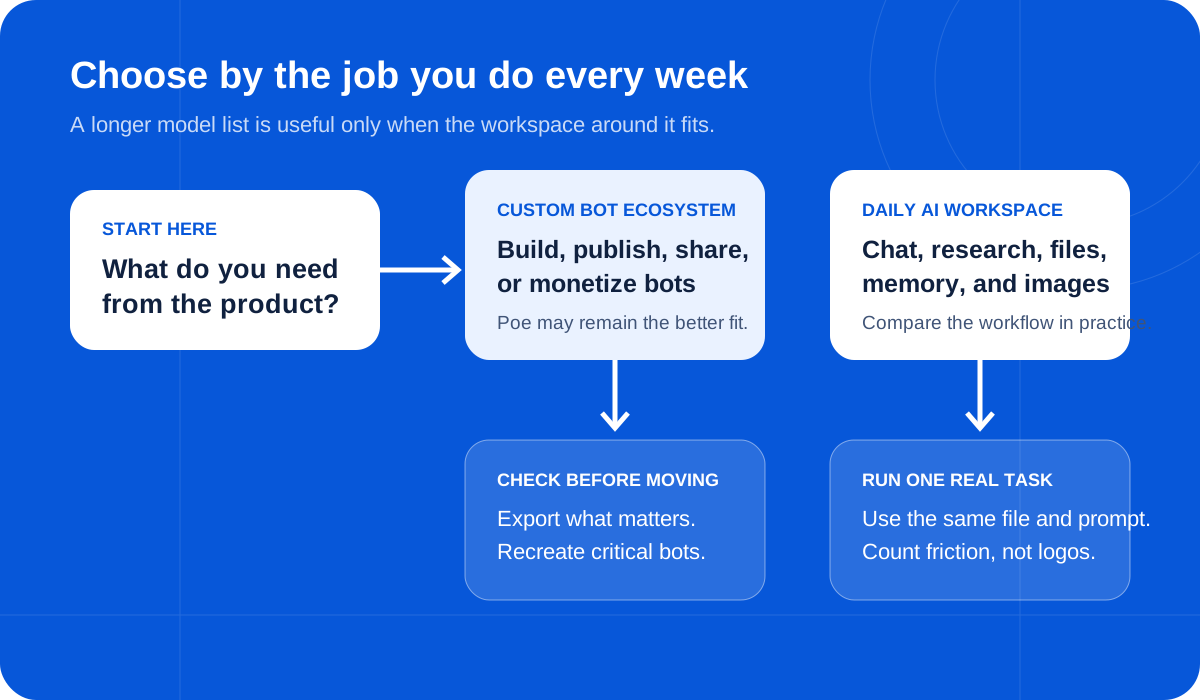
For example, upload a report and ask for a decision memo with page references. Then switch models and ask for a critique. The model output matters, but so do the steps between those outputs.
Ask yourself:
- Did the file stay attached and available?
- Could you switch models without pasting the prompt again?
- Was the earlier conversation still useful after the switch?
- Could you run a web search without starting in another tool?
- Was usage understandable before and after the task?
- Could you find the conversation the next day?
That small trial tells you more than a feature grid assembled from marketing pages.
Compare the features that change everyday work
| What to inspect | Why it matters | A useful test |
|---|---|---|
| Model access | You need the models you actually use, not every model ever released | Name your three regular models and confirm the current versions are available |
| Mid-thread switching | Restarting a chat loses time and often loses nuance | Change models after five messages and ask the new model to critique the thread |
| Memory and context | Long-running work depends on details surviving beyond one answer | Return to a project later and ask about a preference or decision already discussed |
| Web research | Current facts need sources, dates, and links | Research a recent product change and open every cited source |
| File handling | PDFs and documents contain tables, scans, and page-number traps | Upload a real report and verify several quotes and page references |
| Image workflow | Image generation is useful only if iteration is easy | Create an image, revise one detail, and check whether the instruction carries over |
| Usage model | Surprise limits can interrupt work | Complete a normal week-sized task and inspect how usage is reported |
| Conversation organization | Search and retrieval matter once chat history grows | Find an old answer without remembering its exact title |
Do not score every row equally. If you never build public bots, a creator marketplace has little value. If your work depends on a custom bot with a loyal audience, it may be the deciding feature.
When Poe is probably still the right choice
Poe may remain the better home if you actively create, publish, or discover specialized bots. Its breadth goes beyond a collection of general chat models. Poe supports user-created bots, bot monetization, interactive apps, group chats, API access, and several kinds of media generation. That ecosystem is difficult to replace with a product focused on personal productivity.
It can also suit people who like explicit metering. Poe shows rates and lets users set budgets. Its purchase FAQ says subscription points may be granted daily or monthly, while subscribers can buy add-on points for larger projects. If you want detailed control over spend by bot and message, that structure can be useful.
Switching products just because another one claims more models would be a poor trade. You could lose bots, workflows, and history you use every day for a model list that looks impressive but changes nothing.
When a workspace-first alternative makes more sense
A workspace-first product is a better fit when AI is part of ongoing work rather than a series of isolated bot conversations.
Say you are researching a market. You want web sources in the same thread, a PDF attached to the project, one model to map the evidence, another to challenge the conclusion, and enough memory to avoid explaining the company again tomorrow. The value comes from continuity.
The same is true for writing. A useful workspace should hold the brief, source material, edits, and style decisions while you move between drafting and critique. For image work, it should keep the prompt and revisions together. For documents, it should make it easy to return to the exact file and questions. Our guide to summarizing a PDF with AI shows why document structure and page-level checks matter more than a one-click summary.
OrbiChat is built around that workspace model. It brings Claude, GPT, Gemini, Grok, DeepSeek, Qwen, Kimi, image models, web search, files, chat memory, mid-thread switching, and side-by-side answers into one place. It is a better fit for people who want to finish everyday work without treating every model as a separate destination.
That does not make OrbiChat a replacement for every Poe feature. OrbiChat is not trying to reproduce Poe’s public bot creator ecosystem. The stronger reason to choose it is the harness around the models: a cleaner path through chat, research, documents, memory, and images.
A simple migration test
Do not move all your work on day one. Run a short comparison first.
Pick two representative tasks:
- one context-heavy task, such as refining a strategy memo over several messages
- one source-heavy task, such as researching a current question and checking citations
Use the same starting prompt and source file in both products. Keep the test natural. Do not spend an hour tuning one product and five minutes on the other.
At the end, write down:
- how many times you changed tabs or copied text
- whether the second model understood the existing thread
- whether you could trace factual claims to real sources
- where usage limits or costs became unclear
- whether you would want to reopen that workspace next week
You are not running a benchmark here. You are checking whether the product fits. Pick the one that removes more friction from work you actually do.
If you decide to move, export or copy the conversations and prompts you genuinely need. Save source files separately. Recreate critical custom instructions one at a time, and check the new results rather than assuming identical prompts will behave identically across products.
The direct comparison
| Choose Poe when… | Choose OrbiChat when… |
|---|---|
| You build, publish, or monetize custom bots | You want a focused workspace for daily AI work |
| Discovering community bots is part of the appeal | You mainly use leading frontier models directly |
| Group chats, interactive apps, or Poe’s API are central | Memory, files, web research, and model switching are central |
| You prefer bot-level point rates and budgets | You prefer plan allowance shown without pricing each message yourself |
| You need Poe’s wider video or audio creator ecosystem | You want chat and image workflows in a calmer interface |
Poe and OrbiChat solve different versions of the same problem. Poe has a broad creator platform. OrbiChat is narrower on purpose, with more attention on the work that happens between the prompt and the finished result.
FAQ
What is the best Poe alternative?
The best Poe alternative depends on why you use Poe. If you need public custom bots, creator tools, group chat, and a large media ecosystem, Poe may still be the best fit. If you want a calmer workspace for leading chat models, memory, files, web research, and images, OrbiChat is worth testing with a real task.
Is there a Poe alternative with Claude, GPT, Gemini, and Grok?
Yes. OrbiChat provides access to Claude, GPT, Gemini, Grok, DeepSeek, Qwen, Kimi, and supported image models in one workspace. Model availability changes as providers release and retire versions, so check the product before choosing based on one exact model name.
Why does Poe use compute points?
Different models and outputs have different compute costs. Poe uses a shared point pool and publishes rates so those costs can be managed across bots. Some users like that control. Others prefer a plan allowance that does not ask them to consider a point rate for each message.
Can I keep all my Poe chats when switching?
Do not assume another product can import every conversation, attachment, custom bot, or setting perfectly. Preserve important prompts and source files before moving. Start with active projects, then bring over older material only when you need it.
Should I replace separate ChatGPT, Claude, and Gemini subscriptions with one AI workspace?
It can simplify access, but first check which first-party features you rely on. A multi-model workspace may cover your normal chat, research, file, and image needs while direct subscriptions can include provider-specific tools that an aggregator does not reproduce. Test your real workflow before cancelling anything.
Is comparing several AI models always better?
No. One capable model is enough for many routine tasks. A second model helps when the first answer is weak, the decision matters, or you want a critique. Our article on why one AI model is not always enough explains where that extra pass earns its keep.
Media credit: cover photograph by Huy Phan on Unsplash, cropped and overlaid with editorial text by OrbiChat, used under the Unsplash License. Decision diagram by OrbiChat.